

ECCV 2026 brought together thousands of participants from around the world in Malmö, Sweden, to explore the latest developments in computer vision and machine learning.
ECCV is one of the leading international conferences in the field. Computer vision is about enabling systems to understand what a camera sees, such as people, objects and movement, while machine learning allows systems to learn to recognize patterns in the information they receive.
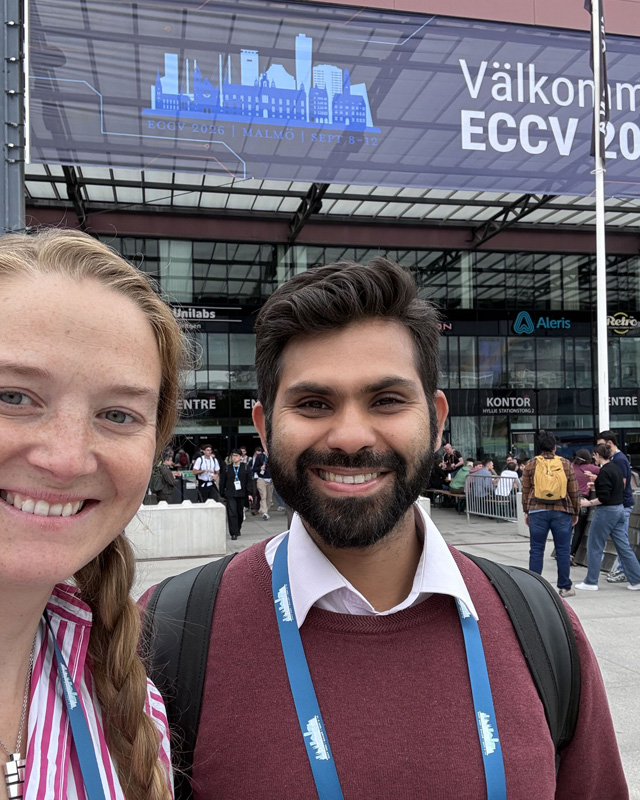
BlincVision’s Karolina Mothander and Amit Suveer attended two workshops focused on event-based and neuromorphic vision. The workshops covered areas such as event data processing, algorithms, hardware and sensor fusion.
Growing interest in event-based vision
One clear impression from ECCV was the strong interest in event-based vision. The workshops attracted many researchers and developers working in the field. Several participants who have been working in the field for many years also described how the event camera community has grown.
Event cameras differ from traditional cameras by detecting changes as they happen, rather than continuously capturing complete images. This provides benefits such as low latency, less motion blur and the ability to handle large variations in light. At the workshop on Neuromorphic Vision (NeVi), applications discussed included autonomous navigation, vehicles and industrial environments where rapid changes need to be detected.
Research labs across Europe are exploring how event-based vision can improve detection in challenging weather and lighting conditions, with applications in areas such as automotive, defence and security.
“It was great to see so many people at the workshops and such strong engagement around event cameras. There is a lot happening in this field,” says Karolina Mothander.
Making better use of event data
One key topic during the workshops was how information from event cameras can be processed even more efficiently. One area that received a lot of attention was spiking neural networks (SNNs), a type of neural network where calculations can be triggered when new information arrives. This allows the processing to better follow the way an event camera works and focus on changes rather than complete images.
Hardware was also discussed. Specialized processors can be used to further speed up the processing of event data.
Much of the research is focused
on areas that we at BlincVision
are already working on. To fully
benefit from event-based vision,
it is not only about the sensor.
How the data is processed,
from algorithms to hardware,
is also important.
/ Amit Suveer
Sensor fusion
Another clear theme at ECCV was sensor fusion, where information from different sensors is combined. Sensors capture different aspects of what is happening in the surroundings and have different strengths depending on the situation and environment. Several presentations explored how event data can be combined with other sensor data to give systems more information about what is happening around them.
“A lot of research still looks at event cameras as a standalone technology. From a commercial perspective, the important question is how event-based vision can add value as part of a complete sensor system,” says Amit Suveer.
At the forefront of technology development
For BlincVision, attending ECCV is about being part of the development of event-based vision and its growing network. The conference provided opportunities to exchange knowledge and talk directly with researchers and other people working in the field.
“It is valuable to be part of the development in this field. Event-based vision is attracting strong interest, with a lot of research happening in the field. Meeting others who, like us, are working at the forefront gives us new perspectives to bring into our discussions with customers and partners,” says Karolina Mothander.